

Shame(ful)(less)
Too much or just enough?

I’ve been oversharing on the internet since 2003. First, this looked like cryptic song lyrics on my AIM away messages, followed by “You know who you are…” As the years went on, MySpace took precedence, and I began sharing every thought and feeling in soul-baring bulletins. Next came Facebook and Twitter, where I’d push the character limit in my photo captions on the moody selfies I strategically took with my family’s old digital camera. All out of the desperate need to be seen and understood.
It wasn’t until I finished the first draft of my book and started publishing on Substack that I realized I just needed a place to fucking write the whole time. So there’s a lot of relief in having this space and even just pretending like a few of you are actually reading it. It’s nice to come on here and do the opposite of hiding. And now I can overshare on here instead!
I’m listening to a new audiobook, and today, while I walked my dog through UT campus, one concept stuck out to me more than the others, likely because it pertains to my current experience in unearthing all that I’ve been taught to hide. In her book Rage Becomes Her, Soraya Chamaly speaks about shame, saying it “infuses women's most intimate experiences.” She also explains that the word shame originates from the old english word “scamu” and is derived from the proto-Germanic “skamo” or “skem” which means “to cover.” And to cover is to hide, isn’t it? At least when you’re forced to cover. If you’re covering something because you want to, hell yeah, love that for you.
It’s interesting to note the general differences between the ways men tend to hide their deep wells of grief behind anger, while women tend to hide their momentous rage behind the softer, more palatable emotion of sadness. I understand this is a gross generalization. This is not true of every human, of course. This is also a very binary way of viewing gender and the world that I don’t personally align with. Yet there does seem to be something there.
Perhaps this is why the leading cause of death in men under 50 is suicide, while something like 80% of women hate their own bodies. Both methods of hiding (stuffing our anger and smothering our sadness) tend to make life unbearable; it makes it impossible to live with ourselves and one another. I have no solution other than a complete overhauling of the systems on which our society is built. So talk amongst yourselves, I suppose.
But I digress. I think that’s maybe what I should call my entire substack: I Digress.
Anyway, I think I was born confident. I think I was born knowing exactly what I wanted to say and had a no-holds-barred attitude about saying it until society stepped in and told me I was too much and that I better shut the fuck up. I believe Glennon Doyle described it best:
Ten is when we learn how to be good girls and real boys. Ten is when children begin to hide who they are in order to become what the world expects them to be. Right around ten is when we begin to internalize our formal taming. Ten is when the world sat me down, told me to be quiet, and pointed toward my cages: These are the feelings you are allowed to express. This is how a woman should act. This is the body you must strive for. These are the things you will believe. These are the people you can love. Those are the people you should fear. This is the kind of life you are supposed to want. Make yourself fit.
-Glennon Doyle, Untamed
Even as a kid, I tried to tell the truth about how fucked up it felt to be alive sometimes, and I got punished for it. Not by my parents or anything, more so by the endless attempts by the forces at large to shrink and change who I was. Because it wasn’t becoming of a young freckle-faced girl. Don’t even get me started on how much I loved my strong, sturdy body as a young kid, only to realize, “Oh shit, big is bad!” when I started school.
My curvier body, even in late elementary school and middle school, led to me getting dress-coded more often than the other girls. I was told I was inappropriate, distracting, attention-seeking, bad. They gave me big jackets from the lost and found and told me to “cover up.” And yes, I get that this is a very literal example.
The point is, I’m done hiding. I’m going to say fuck, shit, damn, and ass in public because it makes jokes funnier and helps me get my point across. I’m going to talk about sex like it’s a normal fucking thing and not some big shameful secret so that maybe we can stop being so weird about it. I’m going to order fries with my burger even if you think I should be on a diet. I’m going to wear the low-cut shirt even though I have huge boobs because I like the way it looks, and if a thinner person with smaller breasts did it, you wouldn’t think twice. And maybe, just maybe, it’s your responsibility not to objectify me, rather than the other way around.
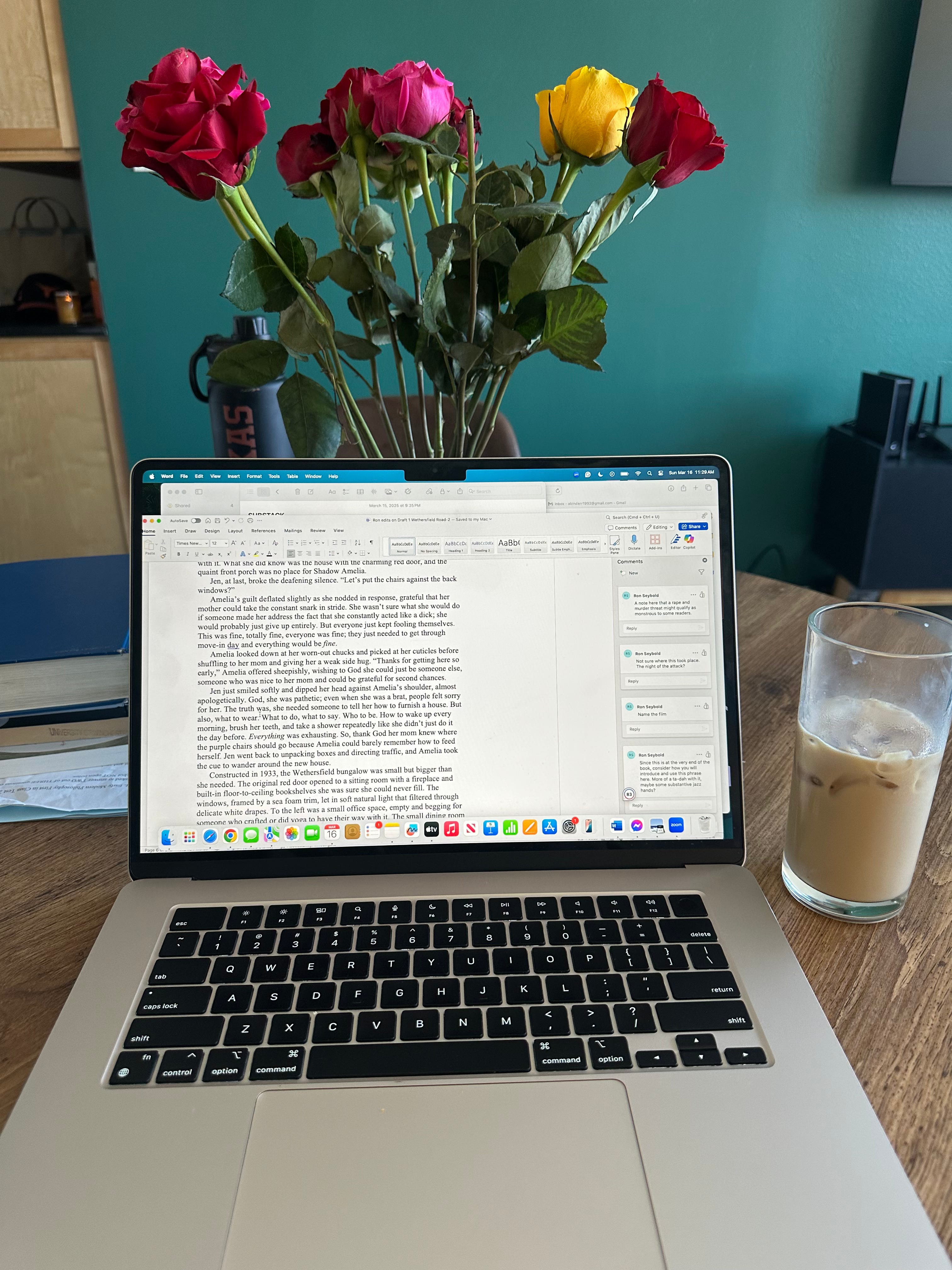
This week, my editor sent me back his edits, and as I go through them word by word, line by line, I’m getting more and more excited to overshare to the tune of my debut novel, Wethersfield Road. And I’m going to keep oversharing because maybe then we can all feel a little less alone. I would rather be shameless than full of shame. As Elyse Meyers would say, if I’m too much, go find less.
I was never just a kid looking for attention. I was also a writer. A writer ready to tell the truth about how dark it gets in my head sometimes and trust that someone out there may relate. Because the writers that did that for me quite literally saved my life.
Keep oversharing and being too much. You may set someone else free.
Anna this is amazing.